
Article: How a Custom Ring Is Actually Made: A Week-by-Week Look Inside Our Montreal Atelier
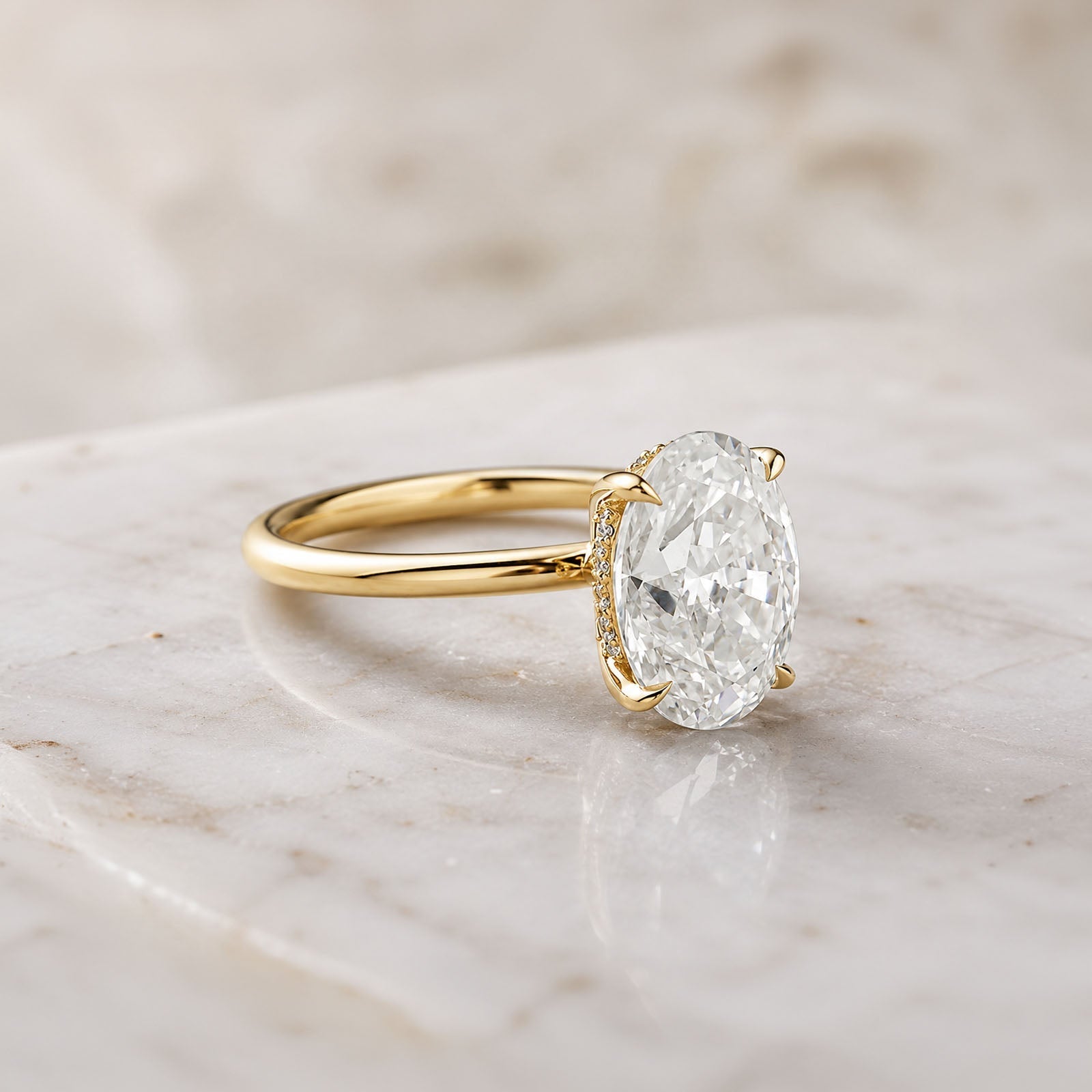
How a Custom Ring Is Actually Made: A Week-by-Week Look Inside Our Montreal Atelier
Most people who walk into our shop on Phillips Square have the same two questions, and they usually ask them in the same order.
How long will it take?
Four to six weeks, in most cases.
How do I know it'll look like what's in my head?
Because you'll approve a photorealistic 3D render — and then a physical wax model of your ring — before we melt a single gram of gold.
That's the short version. But "four to six weeks" doesn't tell you much about what's actually happening during those weeks, or what you're expected to do, or when. So here's the long version: a step-by-step walkthrough of how a ring goes from a screenshot on your phone to a finished piece in a box, based on how we've done it at Ex Aurum since 1989.
The timeline at a glance
| Stage | Timing | What you do | What we do |
|---|---|---|---|
| Brief and quote | Days 1–2 | Describe your ring (about 3 minutes) | A jeweller reviews it and sends a real quote with real stone options |
| Design and stone selection | Week 1 | Consultation, in person or virtual | Source and present centre stones; finalise design details |
| 3D render and wax model | Weeks 2–3 | Review, request changes, approve | Model the ring in CAD, then carve or print a wax |
| Casting, polishing, setting | Weeks 4–5 | Nothing — this is bench time | Cast the metal, hand-finish it, set the stones under microscope |
| Inspection and delivery | Week 6 | Pick up or receive | Multi-point QC, appraisal, insurance and care guidance |
Two honest caveats before we go further. First, rare centre stones can add time — if you want a specific 2.5 ct emerald-cut with a particular colour grade, sourcing may take an extra week or two. Second, every round of design changes resets the clock a little. Most clients approve the render on the first or second pass; if you're on your fifth, we'll tell you kindly, and we'll also tell you it's worth it.
Step 1 — The brief (Days 1–2)
Everything starts with a description of what you want. You don't need to know the vocabulary. You don't need to have decided anything yet.
The Ex Aurum Ring Studio is an online form that takes about three minutes. It asks for:
- Setting style and diamond shape, as best you can describe them
- Natural or lab-grown
- Metal — 18K white, yellow, or rose gold, or platinum
- Ring size, if you know it, and a rough budget
- Any inspiration images: screenshots, Pinterest boards, a photo of your grandmother's ring
That last one matters more than people expect. A single saved image communicates more than a paragraph of description, and it's often the thing that unlocks the whole design.
What happens next is the part we're most particular about: a working jeweller from the atelier reads your submission, not a bot. Within one business day you'll get a real quote back — with specific stone options, actual prices, and notes about anything in your brief that might need rethinking. If your budget and your dream ring don't quite line up, we'd rather tell you on day one and show you what does work at that number.
There's no obligation attached to any of this.
Step 2 — Choosing the stone (Week 1)
Once the quote makes sense to you, we go deeper. You can come to the atelier at Phillips Square to see metals and stones under real light, or we can do it over video — both work, and roughly half our custom clients now do it virtually.
The centre stone is the single biggest decision in the project, financially and visually, so we spend real time on it.
On lab-grown versus natural: lab-grown diamonds are chemically and optically identical to mined ones, and typically cost significantly less per carat, which is why many clients use the difference to go up in size or improve the cut grade. Natural diamonds hold value differently and carry a geological history that matters a great deal to some people and not at all to others. Neither answer is the correct one. We'll show you both, side by side, at the same price point, and you'll usually know within about ten minutes.
On the 4Cs: cut, colour, clarity, and carat, explained without the sales script. The short guidance we give almost everyone: cut is where your money does the most visible work, since it governs how the stone actually returns light. Clarity is where people most often overspend — a VS2 with well-placed inclusions looks identical to a VVS1 to the naked eye, at a meaningfully lower price. And colour tolerance shifts with your metal choice, since a warmer stone that looks off in platinum can look beautiful in yellow gold.
We compare real, available stones — not a catalogue of ideals.
Step 3 — The 3D render and the wax (Weeks 2–3)
This is the stage that removes the guesswork, and it's the reason we almost never have a client surprised at the reveal.
Our design team builds your ring in CAD and sends you a photorealistic 3D render — accurate proportions, accurate profile, accurate stone placement. You can see how tall it sits, how the gallery looks from the side, how the band tapers at the back.
Then you tell us what to change. Common requests, all of them easy at this stage and expensive later:
- A thicker or thinner band
- A lower profile, so it doesn't catch on gloves and sweaters
- Different prong count or shape
- Adjusting the space where the wedding band will eventually sit flush
When the render is right, it becomes a physical wax model. Our goldsmiths handle the wax to check the things a screen can't show: structural integrity, symmetry, whether the metal is thick enough in the places that take daily abuse. Occasionally the wax reveals a problem the render hid, and we'd rather find it in wax than in gold.
Nothing moves forward until you've approved both.
Step 4 — The bench work (Weeks 4–5)
Now the ring gets made. There are three distinct crafts involved, and they're usually done by different hands.
Casting. The wax model is invested in a mould and burned out, and your chosen metal is melted and cast into the cavity it leaves behind. What comes out is a rough, unlovely version of your ring. This is normal. It's supposed to look like that.
Hand-finishing. The cast piece is filed, sanded through progressively finer grits, and polished by hand. This takes far longer than most people imagine, and it's the single biggest difference between mass-produced jewellery and handcrafted work. The mirror finish on a well-made ring isn't a coating — it's a surface that's been worked until it reflects.
Stone setting. The most demanding step, done under a microscope by a specialist setter. They're solving two problems at once: angling the stone so it catches and returns maximum light, and making the prongs or bezel secure enough to survive decades of dishwashing, gym bags, and doorknobs. A beautifully set stone that loosens in two years is a failure. Both things have to be true.
You don't need to do anything during these two weeks.
Step 5 — Inspection and the reveal (Week 6)
Every piece goes through a multi-point inspection before it leaves the atelier. We check prong tension individually, verify the polish under magnification, confirm symmetry, and re-verify the stone against its certification. If anything is off, it goes back to the bench.
With the finished ring you receive:
- A formal written appraisal for your insurer
- Guidance on scheduling it properly on your policy — this is worth doing correctly, and most people don't
- Care instructions, including how often to have prongs checked (we recommend every 12–18 months for a daily-wear ring, and we do it free for our clients)
Then you either come collect it, or we arrange secure, insured delivery. Clients tend to remember this moment fairly vividly. So do we.
Frequently asked questions
How long does a custom engagement ring take? Four to six weeks from approved quote to finished ring, at Ex Aurum. Rare or specifically-graded centre stones can extend sourcing by one to two weeks, and each round of design revisions adds a few days.
Is a custom ring more expensive than buying from a retail case? Not usually. You're paying for materials and craftsmanship rather than for retail markup, inventory financing, and a mall lease. Custom is often comparable or better value at the same budget — the difference is that you get exactly what you wanted.
Can I use stones or gold from an existing piece? Yes, and it's one of the most meaningful things we do. Inherited diamonds can be reset into a new design; old gold can be refined and reused. We'll assess the materials first and tell you honestly what's viable.
What if I don't like the 3D render? You tell us, and we change it. That's the entire point of rendering before fabricating. Revisions at the render stage are expected and included.
Do I need to know the ring size for a surprise proposal? It helps but isn't essential. We can work from an existing ring, a rough estimate, or simply size it after the proposal — most designs can be resized, and we'll flag it during design if yours can't.
Can the whole process be done remotely? Yes. Brief, quote, consultation, render approval, and insured delivery can all happen without you setting foot in Montreal, though you're very welcome to.
Start with a description
You don't need a finished idea. You need about three minutes and a rough sense of what you like.
[Describe your ring in the Ex Aurum Ring Studio →] — a real jeweller responds within one business day with a genuine quote.
Prefer to talk it through with a person first? Book a consultation at our Phillips Square showroom, or call the atelier directly at 514-874-1720.
Ex Aurum has been designing and handcrafting fine jewellery in downtown Montreal since 1989. Our goldsmiths are European-trained, and every piece is made on-site.

